Tuesday, April 14, 2015

Michigan Cavalry in East Tennessee 1863-64


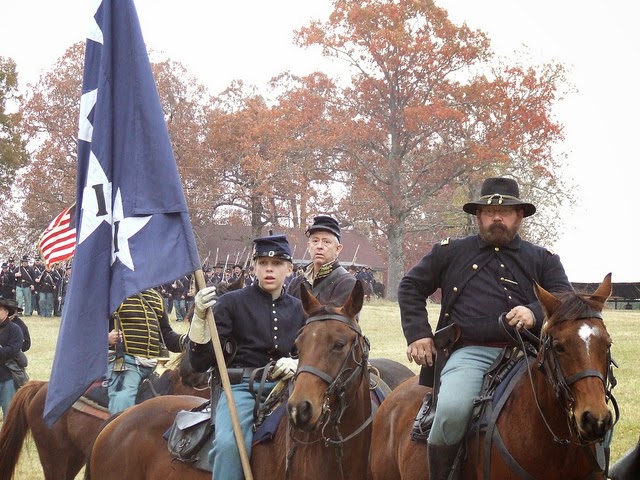
Photo credit: dishfunctional Some rights reserved

8th Cavalry

The regiment then in the 1st Brigade 2d Cavalry Corps and still in command of Colonel Wormer had entered upon the East Tennessee campaign having met the enemy at Kingston September 1st and on the 18th at Cleveland. A correspondent writing to the Detroit Advertiser and Tribune says of the affair at Cleveland:

'From Kingston we were ordered to Post Oak Springs a distance of nine miles. Here we remained over night. The next morning we received orders to go to Athens, the county seat of McMinn county, 35 miles south of Kingston on the line of the East Tennessee and Georgia railroad. At Kingston we had to cross the Tennessee river in a small ferry boat, the rebels having burned all the boats of any size on the river at this point, and above as far as Knoxville. It required one day and two nights to ferry the command the 1st brigade across the river. We were heartily glad when the work was accomplished. We then moved on that day some twenty miles and encamped on Prigmore's farm. Prigmore proved to be a rebel of the deepest dye, and owned a very large plantation, which was under a high state of cultivation. We found an abundance of forage for our horses and mules and quite a large quantity of bacon which the old man had buried in a smoke house to prevent the 'dreaded Yankees' from getting it. After two days sojourn we left for Athens. The 8th Michigan cavalry took the advance and we entered the town amidst the waving of flags the shouts of the people and a shower of bouquets from the hands of the loyal ladies. Such a demonstration was unexpected. We little dreamed that such a strong Union feeling existed in this section. We had heard it said that there were many loyal people in East Tennessee, but had somewhat been led to believe that it was overrated. We were indeed happily disappointed. Crowds of people gathered around Colonel Byrd and expressed their gratitude for being delivered from the oppressive yoke of the bogus confederacy. A large crowd of men and women gathered together and listened eagerly and attentively to the speeches made by Colonel Byrd, Lieutenant Colonel Wormer, 8th Michigan cavalry and Colonel Henderson of the 112th Illinois mounted infantry. Their speeches were received with bursts of applause and every one seemed pleased with the policy of our government as explained by the speakers. We remained at Athens a week or more during which time Captain Samuel Wells of the 8th Michigan cavalry, Acting Provost Marshal on Colonel Byrd's staff administered the oath to over 1,500 rebel soldiers and a large number of citizens. The captain, by the way, is a very efficient officer and attends to the duties of provost marshal in a manner satisfactory to all. While at Athens, Major Edgerly of the 8th Michigan cavalry with one company from the 112th Illinois, one company from the 1st Tennessee and companies G and I of the 8th Michigan cavalry, were sent down to Cleveland 25 miles from Athens on the East Tennessee and Georgia railroad to take possession of the town and hold it if he could. The second day after taking possession he was suddenly attacked by a largo force of the enemy estimated at 1,500, the Major's force numbering 150 and was compelled to beat a hasty retreat. The rebs had laid their plans to gobble up the major and his entire command, but they found that it was not so easily done as they supposed. Although they drove our pickets in, rather unceremoniously the Major was prepared to give them a warm reception. In the skirmish, Captain Dickinson of Company B of the 112th Illinois was killed and 24 of his men taken prisoners. The captain exhibited great courage and would not fall back, nor allow his men to retreat. Major Edgerly fell back in good order, occasionally making a stand and giving the rebels a taste of bullets. Companies G and I covered the retreat and their Spencer rifles told with fearful effect on the advancing enemy. A few volleys from their rifles would always check the rebels and they would hesitate some time before advancing. Arriving at Charleston, on the Hiawasse river, the major made a stand, but the enemy did not think proper to pursue them farther. A number of men belonging to Company G 8th Michigan were cut off and taken prisoners. A great many narrow escapes were made, several horses were shot under their riders, but no one was wounded or killed on our side. Lieutenant McDonald of Company I received a shot through his hat and another through his holster on the saddle. The officers and men praise Major Edgerly for the coolness and bravery he exhibited and the skill he displayed in keeping the enemy from capturing the whole command. But few they state could have managed the retreat so well against so large a force."


The regiment was in engagements with the enemy at:
Triplett Bridge Ky June 19 1863
Lebanon Ky July 5 1863
Sal visa Ky July 7 1803
Cumniings Ferry Ky July 9 1863
Bufriington's Island Ohio July 19 1803
Saliueville Ohio July 26 1863
Loudon Tenn September 2 1863
Cumberland Gap Tenn September 9 1863
Carter's Station Tenn September 21 1863
Zollicoffer Tenn September 25 1863
Leesburg Tenn September 29 1863
Blue Springs Tenn October 5 and 10 1863
Rheatown Tenn October 11 1863
siege of Knoxville Tenn December 5 1863
Morristown Tenn December 10 1863
Russellville Tenu December 12 1863
Bean's Station Tenn December 14 1863
Rutledge Tenn December 15 1863
Dandridge Tenn December 25 1863
Mossy Creek Tenn December 26 1863
Kinsboro's X Roads January 16 1864
Dandridge Tenn January 17 1864
Fair Garden Tenn January 24 1864
Sevier ville Tenn January 27 1864
Strawberry Plains Tenn January 1864
Morristown Tenn March 19 1864
Charles X Roads Tenn March 20 1864
Cynthiana Tenn June 12 1864 

9th Cavalry
The regiment having again been united at Covington, proceeded to Hickman's Bridge and participated in the expedition of General Burnside into East Tennessee, arriving at Knoxville September 3rd, having skirmished at Loudon on the 2nd. From Knoxville it proceeded to Cumberland Gap. On the 7th, a detachment of the regiment drove in the rebel pickets, entered the Gap, and burned a large mill, on which the enemy depended, to a great extent, for subsistence. Loss of the regiment one killed and one wounded.


Loudon Tenn September 2 1863
Cumberland Gap Tenn September 9 1863
Carter's Station Tenn September 21 1863
Zollicoffer Tenn September 25 1863
Leesburg Tenn September 29 1863
Blue Springs Tenn October 5 and 10 1863
Rheatown Tenn October 11 1863
siege of Knoxville Tenn December 5 1863
Morristown Tenn December 10 1863
Russellville Tenn December 12 1863
Bean's Station Tenn December 14 1863
Rutledge Tenn December 15 1863
Dandridge Tenn December 25 1863
Mossy Creek Tenn December 26 1863
Kinsboro's X Roads January 16 1864
Dandridge Tenn January 17 1864
Fair Garden Tenn January 24 1864
Sevierville Tenn January 27 1864
Strawberry Plains Tenn January 1864
Morristown Tenn March 19 1864
Charles X Roads Tenn March 20 1864
Cynthiana Tenn June 12 1864

10th Cavalry
Engagements and skirmishes of the regiment were:
House Mountain Tenn January 1864
Bean's Gap Tenn March 26 1864
Rheatown Tenn April 24 1864
Jonesboro Tenn April 25 1864
Johnsonville Tenn April 25 1864
Watauga Tenn April 25 1864
Powder Spring Gap Tenn April 28 1864
Dandridge Tenn May 19 1864
Greenville Tenn May 30 1864
White Horn Tenn May 31 1864
Morristown Teun Jane 2 1864
Bean's Station Tenn June 16 1864
Rogersville Tenn June 17 1864
Kiugsport Tenn June 18 1864
Cany Branch Tenn June 20 1864
New Market Tenn June 21 1864
Moseburg Tenn June 23 1864
Williams Ford Tenn June 25 1864
Dutch Bottom Tenn June 28 1864
Sevierville (725)Tenn July 5 1864
Newport Tenn July 8 3864
Morristown Tenn August 3 1804
Greenville Tenn August 4 1864
Mossy Greek Tenn  August 18 1864
Bull's Gap Tenn August 21 1864
Blue Spring Tenn August 23 1864
Greenville Tenn August 23 1864
Strawberry Plains Tenn August 24 1864
Flat Greek Bridge Tenn August 24 1864
Rogersville Tenn August 27 1864
Bull's Gap Tenn August 29 1864
Greeneville Tenn September 4 1804
Sweetwater Tenn September 10 1864
Thorn Hill Tenn September 10 1864
Sevierville Tenn September 8 1864
Jonesboro Tenn September 30 1864
Johnson Station Tenn October 1 1864
Watauga Bridge Tenn October 1 and 2 1864
Chucky Bend Tenn October 10 1854
Newport Tenn October 18 1864
Irish Bottoms Tenn October 25 1804
Madisonville Tenn October 30 1864
Morristown Tenn November 20 18G4
Strawberry Plains Tenn November 23 and 24 1864
Kingsport Tenn December 12 1864
Bristol Tenn December 14 1834
Saliville Va November 20 1864
Chucky Bend Tenn January 10 3865
Brabson's Mills Tenn March 25 1865

(Source: Michigan in the War, Michigan. Adjutant-General's Department, State Printers, 1882)


Thursday, April 9, 2015

Where was your family when Lee's Surrendered to Grant?


Hartsell Good: 4th Regiment, Tennessee Infantry, died before Lee surrendered to Grant.  He is buried in the National Cemetery in Nashville


William Elbert Milburn: Chaplin Tennessee 8th Calvary, was in Knoxville, Tennessee


John Francis M Bails: Tennessee 8th Calvary, was in Knoxville, Tennessee


Wiley Bailey: 7th Regiment, Tennessee Mounted Infantry, was in Athens, Tennessee

Tuesday, April 7, 2015

Michigan Twentieth Regiment Infantry in East Tennessee

Photo Credit xray10  Some rights reserved


Twentieth Regiment Infantry
The 10th of September, 1863, participated in the movement on Knoxville Tennessee marching via Cumberland Gap October 10th, the regiment took part in the engagement at Blue Springs with a loss of one killed and two wounded. The 20th was, on the 1st of November, 1863, at Lenoir Station, East Tennessee, where it remained until the 14th. The enemy making, at this time, their advance toward Knoxville, the regiment was ordered to Hough's Ferry, with other forces to check their advance, but on the 15th, fell back to Lenoir Station, the regiment covering the retreat, and holding the Loudon Road during the night. On the 16th, the army continuing the retreat to Knoxville, the 20th with the 2nd, and 17th Michigan Infantry, were constituted the rear guard. The enemy followed them up with great vigor and at times pressed them very heavily. At Turkey Creek, near Campbell's Station, the rear was attacked by the enemy in force, but successfully sustained the attack for over two hours, when they were reinforced. The loss of the 20th during this action was 33 in killed and wounded. Among the former was its commanding officer Lieutenant Colonel Smith. The commanding officer's report says:

"On the 16th November, our army commenced moving back on Knoxville and the 20th 2d and 17th Michigan regiments were constituted rear guard to army a post of great honor and responsibility as the enemy were pressing us very heavily. When we reached Turkey Creek, McLaw's rebel division attacked us with vigor and we became heavily engaged. Among the first who fell was Lieutenant W Huntington Smith, who had commanded the regiment several months. He was brave and efficient officer and his loss is deeply felt by the regiment.

On the morning of the 17th, the regiment, in command of Major Cutcheon, arrived at Knoxville, having marched all night over bad roads, it being the third night that it had been without rest. The enemy made their appearance before Knoxville on the 17th, and commenced the siege, which continued until the 5th of December. On the 29th of November, it assisted in repelling the desperate assault made on Fort Saunders, losing two killed and eight seriously wounded. Thirteen of the regiment on picket at the time were reported missing. From commanding officer's report is taken the following: At Knoxville the regiment occupied a position on the most exposed part of the line and lost heavily in the trenches. Captain WD Wiltsie who fell during the siege was an officer of great ability zeal and courage. He was mortally wounded on the 25th of November and died on the 27th of the same month.

Troop Action Summary
Blue Springs Tenn October 10, 1863

Loudon Teun November 14, 1863
Lenoir Station Tenn November 15, 1863
Campbell's Station Tenn November 16, 1863
siege Knoxville Tenn November 17 to December 5, 1863
Fort Saunders Tenn November 29, 1863
Thurley's (Turley's) Ford Tenn December 15 1863
Plains Tenn January 22, 1864
Chucky Bend Tenn March 14, 1864
 

Tuesday, March 24, 2015

Siege of Knoxville: Peparations


"It was determined by the Federal authorities to make strenuous efforts during the summer of 1863 to effect permanent lodgments in East Tennessee, both at Chattanooga and Knoxville, not only for the purpose of interrupting railway communication by that route, but to afford relief to a section where Union sentiments were known to exist to a very considerable extent. It was accordingly arranged that Rosecrans should move from Murfreesboro against Bragg, while a force should be organized in central Kentucky to move toward Knoxville in cooperation. The latter movement was intrusted to General Burnside, who occupied Knoxville on the 2d of September, 1863, with part of the Twenty third Corps, and on the 9th, received the surrender of the Confederate force under General John W Frazer at Cumberland Gap.


Defense of Knoxville

It was determined by the Federal authorities to make strenuous efforts during the summer of 1863 to effect permanent lodgments in east Tennessee, both at Chattanooga and Knoxville, not only for the purpose of interrupting railway communication by that route, but to afford relief to a section where Union sentiments were known to exist to a very considerable extent. It was accordingly arranged that Rosecrans should move from Murfreesboro against Bragg, while a force should be organized in central Kentucky to move toward Knoxville in cooperation. The latter movement was intrusted to General Burnside, who occupied Knoxville on the 2d of September, 1863, with part of the Twenty third Corps, and on the 9th, received the surrender of the Confederate force under General John W Frazer at Cumberland Gap.

The greater portion of General Burnside's force was now expected to move down the Valley of the Tennessee to a connection (possibly a junction) with Rosecrans, then at Chattanooga or its vicinity. This involved leaving Knoxville to be held by a small force, and rendered it necessary to fortify the place. Accordingly, as chief engineer, I was instructed to arrange for a garrison of 600 men, intended only to hold the place against a cavalry dash. During the enemy's occupation of Knoxville, a very small beginning had been made toward the erection of earth works. An insignificant line had been thrown up on the hill north west of the college and a slight epaulement on the bluff overlooking the railway station.


Neither of these was of use in the construction of our works. The plans for two works were submitted- one afterward known as Fort Sanders, on the site of the imperfect work first mentioned, and the other afterward known as Fort Huntington Smith, on Temperance Hill in East Knoxville. These plans were approved by General Burnside, and work was at once begun by the engineer battalion of the Twenty third Corps and a small force of negroes, but progressed slowly on account of the difficulty of getting suitable materials. The forts were not entirely completed until after the siege of Knoxville. Meanwhile our lines were extended down the valley toward Chattanooga. By the 18th of September a battalion of cavalry in the extreme advance reached Cleveland, and the prospect for a junction was good until Chickamauga put an end to further movements in that direction, and Sweetwater became our outpost.

Early in October a force of the enemy under General John S Williams, coming from the eastward, moved down the railroad to the vicinity of Bull's Gap, and pressed heavily upon our forces in that quarter. With such troops as could readily be concentrated, General Burnside attacked them at Blue Springs on the 10th and drove them well back toward Bristol. On the 22d of October our outpost at Sweetwater and our reserve at Philadelphia were attacked successfully. Subsequent operations and reconnaissances resulted in the determination to abandon temporarily the Valley of the Tennessee south of Loudon. The troops were all withdrawn and the pontoon bridge was transferred from Loudon to Knoxville, where General Sanders's cavalry command crossed it to the south side of the river, on the lst of November. The abandonment of London had in view the occupation of a stronger position on the northern bank of the river from Kingston to Lenoir's, where a pontoon bridge was to be thrown across the Holston, and the line prolonged by the right bank of the Little Tennessee.

On the 13th of November it was ascertained that the enemy had constructed a pontoon bridge at Hutf's Ferry, near Loudon, and were crossing in force to the northern bank of the Tennessee. At the same time General Wheeler, with nearly the whole of his four brigades of cavalry, made a rapid night march and crossed the Little Tennessee with a view to cutting off Sanders's command, and occupying the heights opposite Knoxville, or as stated by Longstreet, 'failing in this to threaten the enemy at Knoxville so as to prevent his concentrating against us before we reached Knoxville.' Wheeler was foiled in this attempt and soon withdrew to the north bank of the river, which he crossed at Louisville. He rejoined Longstreet on the 17th of November, after the latter had fought the battle of Campbell's Station.

Upon learning of Longstreet's movement, General Burnside took personal command of the troops available to oppose him. The operations of our forces during the next few days had for their object to delay the advance of the enemy to enable us to get our trains into Knoxville, and to forward the defensive works at that place, where it had been determined to make a stand Longstreet advanced from Loudon in two columns. McLaws's division taking the left road, leading to Campbell's Station, and Hood's division (commanded by Jenkins), the one to the right, following the line of the railroad to Lenoir's. The latter soon came in contact with the Federal skirmishers and drove them slowly back but failed to reach Lenoir's that day. Every effort was made during the night to ascertain Burnside's movements, but his bold and vigilant rear guard succeeded in completely concealing them. By daybreak the whole force was on the road, and when the Confederates advanced they found Lenoir's deserted.

The road upon which Burnside was moving, followed by Jenkins, intersects that along which McLaws was advancing, about a mile south west of Campbell's Station. It was therefore essential to the safety of his train, if not of his entire command, that Burnside should reach the junction before McLaws. Just before daylight on the 16th of November, Hartranft's division took the advance of Burnside's column from Lenoir's and pushed forward as rapidly as the roads permitted, followed by the trains and by the other troops. McLaws, with full knowledge of the importance of seizing the intersection of the roads, was making every endeavor to get possession before the arrival of Burnside. He was opposed by a small force, but his march like Hartranft's, was impeded by the mud resulting from heavy rains. It thus became a race for the position. Hartranft won by perhaps half an hour, and turning west on the Kingston road, quickly deployed his division in such manner as to confront McLaws, and at the same time cover the London road along which our trains were moving.

During the movement from Lenoir's, Burnside's rear guard, composed of Colonel William Humphrey's brigade, had several sharp encounters with Jenkins's advance, in which Humphrey handled his forces so well as to excite the admiration of both friends and foes, always standing long enough, but never too long.

Scarcely had Hartranft's dispositions been made when McLaws appeared and attacked, but Hartrauft steadfastly held his ground until the remainder of our troops and all our trains had safely passed. The trains continued on the road to Knoxville, while the troops were formed in line of battle about half a mile beyond the junction, with Ferrero's division on the right, and White's in prolongation to the left, whereupon Hartranft withdrew from his advanced position and took his place in line on the left of White. A small cavalry force scouted the roads on each flank of the line. About noon Longstreet unsuccessfully attacked our right, and afterward our left center. Later, taking advantage of a wooded ridge to conceal the march, he attempted to turn our left flank with three brigades of Jenkins's division, but our scouts soon discovered and reported the movement. Burnside had determined to retire to a new position about two thirds of a mile to his rear, and this development but slightly hastened his withdrawal from the first line. The difficult and hazardous undertaking was successfully accomplished in the face of the enemy. All who saw it say that the troops moved with the greatest coolness, deliberation, and precision under a heavy and continuous fire.
McLaws's division promptly advanced to attack the new position, while Jenkins continued his turning movement, but the difficulties of the ground delayed him until nightfall and stopped his further progress. McLaws attacked and failed to make an impression, and at the close of the action Burnside remained in possession of his own ground until after dark, and then continued his movement to Knoxville, the head of his column appearing there about daybreak next morning November 17th. He had gained his object and therefore was fairly entitled to claim a victory.
Burnside placed his whole loss in this important affair of Campbell's Station at about 300, Jenkins reported his as 174. It is probable that the losses on both sides, including McLaws's, were about equal.


During the fight Burnside had instructed me to select lines of defense around Knoxville and have everything prepared to put the troops into position as fast as they should arrive. I was well acquainted with the ground, and but little further examination was necessary to enable me to designate, in writing, the proposed location of each organization. The topographical features of the vicinity of Knoxville give that place decided strength as a military position. {See maps pp 636 and 736} On the northern or right bank of the Holston, a narrow table land, or ridge, beginning about two miles east of the town extends down the river to Lenoir's some 24 miles. This ridge is generally elevated about 150 feet above the river, but with many higher points. Its width at Knoxville is about 1300 yards, and the valley bounding it on the north-west, parallel with the river is perhaps 50 feet above that stream at the ordinary stage of water. The East Tennessee Virginia and Georgia railroad is located along the valley, which was almost entirely clear of timber. At short intervals the ridge is cut through by small streams emptying into the Holston, two of which called First and Second Creeks, run through the town at a distance apart of about one thousand yards. The main portion of Knoxville, as it existed at the time of the siege, occupied that portion of the table-land included between the two creeks, the river and the valley. East Knoxville was situated next east of First Creek, upon an elevation known as Temperance Hill. East of Temperance Hill, and separated from it by a depression in the ridge, is Mabry's Hill, the highest ground on the north side of the Holston within cannon range of the town. Beyond this the ground with a few minor elevations gradually descends to the level of the valley. Flint Hill is immediately upon the bank of the river, south of Temperance Hill. Third Creek a little more than a mile westward from Second Creek, forms the south-westerly limit of another natural division of the ridge including the hill north west from the college. North-westerly from the river are found successive ridges; the most important was occupied by the Confederates, across the valley a mile from our line. South of the Holston the ground rises in a series of prominent points, or knobs, the highest of which is directly opposite Knoxville on the prolongation of Gay street. These knobs form a range, the crest line of which is parallel with the river at an average distance from it of about half a mile, with a wide valley beyond.
On the Knoxville side of the Holston, our line rested upon the river about a quarter of a mile below the mouth of Second Creek extended from there at an angle of about 82° with the river for 900 yards to Battery Noble, then bending about 50º to the northward continued a little more than 600 yards to Fort Sanders, where it changed direction about 65° to the eastward, and overlooking the valley followed the crest of the bluff, parallel with the general course of the river, for some 1600 yards to Battery Wiltsie, opposite the railroad station, including in this part of the line Battery Zoellner between Fort Sanders and Second Creek, Battery Galpin, just east of Second Creek, and Fort Comstock, between Battery Galpin and Battery Wiltsie. From the last named, with a slight change of direction toward the river, the line continued along the crest of the bluff, over Temperance Hill to Mabry's Hill, a distance of 2400 yards, including Battery Billingsley, just west of First Creek, Fort Huntington Smith on Temperance Hill, Battery Clifton Lee, and Battery Stearman, in the depression between Temperance Hill and Mabry's Hill, and Fort Hill on the extreme easterly point of Mabry's Hill. From here it turned sharply to the southward for 1300 yards and reached the river at a ravine about 1000 yards above the mouth of First Creek. A continuous line of infantry cover connected all these positions and dams were built at the crossing of First and Second Creeks which, by backing the water, formed considerable obstacles, especially in front of Temperance Hill where the line was parallel with the course of First Creek for 1200 yards and the pond impassable without bridges. A short interior line was established from Fort Sanders to Second Creek near its mouth. This included Fort Byington built around the college. Another line extended from Temperance Hill to Flint Hill terminating in Battery Fearns.
On the south side of the river such of the heights (four in number) as were necessary to the defense were occupied by detached works with extensions for infantry cover, insufficient, however, to make the line continuous, or even approximately so. Fort Stanley was built on the hill directly opposite Knoxville, and a line of ordinary rifle-trenches was carried eastward from it across the Sevierville road and to the adjacent height. The hill nearly opposite the mouth of Second Creek was occupied by Fort Dickerson, and the next one to the westward by Fort Higley.
The arrangements for the defense of the position on the north side of the Holston were necessarily made in the most hurried manner. The earth works known as Fort Sanders and Fort Huntington Smith, intended for a very different condition of affairs, were so far advanced toward completion when Longstreet appeared before Knoxville, that their use without modification was compulsory. Neither of the plans was what it would have been had the works been designed for parts of a continuous line. Especially was this the case with respect to Fort Sanders, the trace of which was such that under the stress of circumstances its north western bastion became a prominent salient of the main line, and notwithstanding the measures taken to remedy this objectionable feature its existence caused us great anxiety. The sector without fire of the bastion referred to (the one attacked) would have been a sector without fire for the line, but for the arrangements made on either side of it to overcome the defect as far as possible. The fire thus obtained in front of this bastion was not all that could have been desired, but the event proved that it was sufficient. That Longstreet's renowned infantry failed to carry it by assault demonstrated that there were no very serious defects unprovided for. 

(Source: Battles and Leaders of the Civil War: Being for the Most ..., Volume 3, Part 2, edited by Robert Underwood Johnson, Clarence Clough Buel)


Saturday, March 21, 2015

Michigan Seventeenth Infantry in East Tennessee

Photo Credit xray10  Some rights reserved


August: From Kentucky arriving at Crab Orchard August 24th, 1863. Marching from Crab Orchard, it engaged in the movements made by the army of the Ohio into East Tennessee in September and October. With its division it moved from Knoxville to Blue Springs, but did not participate in the engagement at that place. Returning to Knoxville on the 14th of October, it marched from thence on the 20th, and proceeded via Loudon to Lenoir. Like the 2nd, 8th and 20th Infantry, which were in the same corps, the 17th had traveled over 2,100 miles during the year. The regiment in command of Lieutenant Colonel Comstock, and then attached to the 3d brigade, of the 1st division. 9th army corps, remained at Lenoir Station, East Tennessee, until the morning of the 14th of November 1863, when it marched to the Tennessee river, below Loudon, to oppose the advance of the rebels under Longstreet, then moving on Knoxville. It lay under arms during the night and on the following morning commenced falling back, closely followed by the rebel forces. It continued to retreat on the 16th, with its corps, its brigade, moving in the rear of the army, and the regiment acting as the rear guard. While crossing Turkey Creek, near Campbell's Station, the enemy attacked in force, and a severe engagement ensued. In this action the loss of the regiment was 7 killed, 19 wounded, and 10 missing. From a report of Captain FW Swift: On the 16th, we marched for Knoxville. Our regiment being detached as rear guard was attacked by the enemy's advance guard about 9 30 AM, near Campbell's Station, and after severe fighting through the day, we retired during the night to Knoxville. Lieutenant Alonzo P Stevens was mortally wounded. During the night of the 16th, the 17th moved with the army to Knoxville, assisting actively in the defense of that town, while besieged by the enemy. On the night of the 20th, the regiment, under the command of Lieutenant Colonel Comstock, was ordered to burn a house occupied by the enemy's sharpshooters. This was done successfully, but while returning to camp a shell from one of the enemy's guns killed instantly Lieutenant Josiah Billingsley. A correspondent of the New York Tribune, under date of November 20th, 1863, writes Brilliant Sortie of the 17th Michigan:

At 8.30 PM rapid cannonading was heard on our west frontier Fort Saunders which aroused the town from its temporary repose. Now it was supposed the expected night attack had begun. The advance it seems was by our side and not from that of the enemy. The rebel pickets, during the day, had got into James Armstrong's house, just under the hill, and had very much annoyed our men. General Ferrero, accordingly, ordered the 17th Michigan to make a sortie and drive them out. The work was handsomely accomplished and the house was set on fire. They then fell back but as the light of the burning buildings burst forth, it revealed the position of our men as they were deploying into the road, and the enemy swept their ranks by discharges of shell and solid shot. One lieutenant was killed and three men wounded. Our batteries replied as fast as possible, covering our men as they retreated. The object was accomplished though after sacrifice of valuable men and the Michigan boys deserve much praise for the handsome manner in which they executed their task.

On the 25th a musket ball, from the enemy's skirmish line, struck Lieutenant Colonel Comstock, wounding him so severely that he died the same evening. Following the death of Lieutenant Colonel Comstock, Captain Swift assumed command of the 17th. On the night of the 28th of November, the skirmish line of the regiment was driven in, and 16 men were captured by the rebels. On the 29th it was engaged in the defense of Fort Saunders. During the retreat to Knoxville, and during the siege, the men suffered greatly, especially while besieged from the want of proper and sufficient rations. On the 7th of December, the 17th, in command of Lieutenant Colonel Swift, who bad been commissioned to rank from November 26th moved from Knoxville, in pursuit of the enemy, who had abandoned the siege and were retreating up the valley toward Morristown. Advancing to Rutledge, the regiment remained there until the 15th, and thence fell back to Blain's Cross Roads. It encamped here until the 16th of January 1864, suffering much from want of supplies. Early in March the regiment moved up the valley as far as Morristown. On the 17th, the 9th corps, having received orders to report at Annapolis Maryland, the regiment proceeded to Knoxville where it arrived on the 20th and on the 22nd, it commenced its march over the Cumberland mountains to Nicholasville Kentucky.

Troop Action Summery
Blue Spring Tenn October 10, 1863
Loudon Tenn November 14, 1863
Lenoire Station Tenn November 15, 1863
Campbell's Station Tenn November 16, 1863
siege of Knoxville Tenn November 17 to December 5 1863
Thurley's Ford Tenn December 15, 1863
Fort Saunders Tenn November 29, 1863
Strawberry Plains Tenn January 22, 1864


(Source: Michigan in the War, Michigan. Adjutant-General's Department, State Printers, 1882)
 

Friday, March 20, 2015

Michigan Second Regiment Infantry in the Knoxville area 1863-1864

Photo Credit xray10  Some rights reserved


Michigan Second Regiment Infantry

November 24, 1863

The regiment is mentioned in connection with the operations at Knoxville on the 24th in the "Rebellion Record" as follows: 
 
November 24th Skirmishing commenced early and briskly on our left front this morning. The rebels had gained a hill and thrown up rifle pits near the round house during the night. The 48th Pennsylvania and 21st Massachusetts, during the morning, charged the pits and driving the rebels out at the point of the bayonet, covered the trenches and returned to their own with a loss of two killed and four wounded. On our left, for some hours, the fire of the sharp shooters was quite hot from a house above the rebel trenches. The 2d Michigan charged there also in the most gallant manner and drove the rebels back. A fierce and bloody engagement ensued with great loss on both sides, our boys remaining in possession of the works which they obliterated, and fell back.

From the New York Tribune:

"About 8 o clock AM, November 24th, General Ferrero, acting under orders, sent forward the 2d Michigan to charge the enemy's rifle pits and drive them out. The regiment was sustained by our batteries as long as it was safe to fire over the heads of our men. They went down the long slope ,over the fallen trees, and through the debris in front, upon the double quick, attacking, driving out the rebels from their pits and occupying them for about half an hour, fighting hand to hand with the rebels over the impalement. They met, however, a whole brigade, and being overpowered sent back for reinforcements. Meantime Adjutant Noble and Lieutenant Galpin were killed, and Major Byington was badly wounded, Lieutenant Zoellner mortally besides a large number of men. The Major, seeing that the effort to hold the place was fruitless. ordered his men to retire. He was immediately made a prisoner."
The extreme suffering from cold and hunger of Burnside's army at Knoxville was without a parallel in the whole war. Following is a memorandum of an inspection of one brigade which unquestionably represented the condition of Burnside's entire army at that time: 


Regiments in the brigade: Second Michigan Infantry, One Hundredth Pennsylvania, Tewentieth Michigan Infantry, Seventh Michigan Infantry, Provost Guard


Without undlothing: 374
No shoes: 386
No blankets: 65
No overcoat: 471
No tents: 218
No socks: 657
No pantaloons: 295
No coats: 186


Sunday, March 15, 2015

Looking beyond the shaking leaf


When I first started looking for the parents of John FM Bails, I got several hints and all of them listed Caleb Bails as his father.  In 1850,  Caleb was listed on the 1850 Greene County census with a son named John who was born in 1846. Everything about this looked good enough on paper, but something about this did not seem right. For one thing, there was not a single person in my family named Caleb. I rationalized by saying that they could have had a son named Caleb who died at a young age, but I still had serious doubts.

Next I found John's death certificate on an index and ordered a copy. The death certificate said unknown. This was really disappointing! 

So, I ordered John's complete Civil War file from NARA. It cost about a sixty dollars and contained more than 100 pages. Reading through the depositions, I found one by Dr. John Blair White, who stated that he was John FM's uncle. That was very interesting because my G Grandfather had a cousin who visited him named White. First guess would have been that this was his wife's cousin because my G Grandfather married a woman with White as a last name. However, one on my Aunt's was sure that it was my Great Grandfather's cousin.

So, I began to search for Beals, Bales, Bails or Bailes who married a woman with the last name White. I found Thomas Beals and Martha Emeline White. They were married on September 10, 1840 in Greene County. Martha Emeline White's parents were well documented (Frederick Tillman White and Deborah McNeese) and she had a brother named John Blair White who was the doctor in John F M's Civil War pension file!

So, I began to search for this family. On the 1850 census, John is listed as Francis M Beals. On the 1860 census, he is listed as John FM Bayless. I believed that I had found the right family! Later, I found additional court records to confirm this.

When I found Thomas Beals, this was the first time that I had seen the name spelled this way. In the years since this first discovery, I have been able to document this family back to John Beals and Mary Clayton, who were married in 1682 at Chester Monthly Meeting in Delaware County, Pennsylvania.