Saturday, May 9, 2015

A Mother's Day Post: Martha Elizabeth White


Martha Elizabeth White was born on April 10, 1882, in Rheatown, Tennessee, her father was James Randolph White and her mother was Mary Mary Ann Emily Good. Her grandparents were: Isaac White and ELizabeth J Morley and Hartsell Good and Martha Milburn.


She married James Ruble Bailes on August 16, 1903, in Greene, Tennessee. They were married by the Reverend T. D. Roe in the Methodist Church in Rheatown.
James Ruble Bailes was the son of John FM Bails and Delphia Coldwell. Her husband served in CO F of the 8th Infantry and was sent to Peurto Rico during the Spanish American War.
They had 13 children in 20 years: Minnie Eva, James Ralph, Walter Randolph, William Howard, Mary Ellen, Lynn, Lillian Geraldine, Henry Kenneth, Carl Ruble, Eleanor Hassie, Hartsell Luther, Frank White and Robert Wilford.

Mrs. Bailes endured much hardship during her life. Her younger siblings, Elbert Carl and Elma both died young. Elma and Carl were twins, Elma died shortly after she was born and Carl died of pneumonia in 1915. Her brother James Henry White was killed during WW I. Her children, James Ralph, Mary Ellen and Lynn died when they were very young.
She worked hard to care for her family and her home was the gathering place for our family for many years. She purchased a washing machine and did laundry for the barber shop where her husband worked and also for some of her neighbors.

Mrs. Bailes was not a Great Grandmother who rocked me sleep or read me bedtime stories. Yes, I called my Great Grandparents Mr and Mrs Bailes. I was the first great grandchild and no one ever suggested that I call them anything else.

Her son Howard comitted suicide on Farragut Ave, near Sharp's Ridge on 28 May 1942. Her sons: Walt, Carl, HL, Frank and Bob and grandson Walter (Buddy) all served in World War II. Hartsell Luther was killed on May 30, 1945 in Luzon, Phillipines.


HL and Howard


Through the years we continued to gather at their house, even though many of their children had larger homes. I am not sure how we managed to fit in their house- surely the laws of physics must have been stretched to the limits!   I remember the house being filled with people, but it never seemed crowded. We met at Christmas and sometimes just for Sunday lunch. The table was always overflowing with food, but what I remember most was seeing my Aunts and Uncles and my cousins. What a gathering of cousins! Sometimes we would take our plates and sit on the floor in the hallway while we were eating.

We also met at their home in times of sadness. It was a place to be with family when a dear friend or family member died too.

Her son, and my Grandfather died on March 13, 1957 at their family home and Mrs Bailes died on December 4, 1957. Her death was the first time that our family gathered at their home without her and her absence was sorely missed. I do think that she was proud of how everyone continued with the traditions that she had started.


Although I dont't have any warm, fuzzy memories to share (don't worry, I have many wonderful memories of my Aunts and Uncles), I did learn some very important lessons for her and for these, I am thankful.

I learned the importance of service and the meaning of sacrifice for our country. 

 Her Grandfather Hartsell Good was killed in the Civil War, her husband served in the Spanish American War and suffered side affects from an illness he contacted while serving over seas. She lost her brother during WW I, in a battle near Chateau-Thierry, France. She saw five sons and one grandson go off to war and only four sons return.

I learned the importance of perseverance and hard work. 

 Raising a family during the Depression was not easy and supporting a large family on a barber's salary meant that everyone had to work.

I learned the importance of faith.


I learned the importance of family: 

“Other things may change us, but we start and end with family” Anthony Brandt


I think that she must have learned a lot of these lessons from her Mother, Mary Ann Emily Good (Molly), because when Molly died, this is what her husband had engraved on her headstone:

"She was a kind and loving wife, a fond Mother and a friend to all."


I think this was true for Martha Elizabeth White Bailes too.


Tuesday, May 5, 2015

John Mason Boyd


Doctor John Mason Boyd-A Great Physician
Malford W Thewlis MD
WAKEFIELD RI
"If all his deeds were flowers, the air be strong with perfume. If all his were melodies, a symphony would fill the sky." 


In Knoxville Tennessee, there is a beautiful monument at the gate of the Court House which reads 'Dr John Mason Boyd Our Beloved Physician Erected by a Grateful Public.' In Europe it is not uncommon to see monuments of great physicians, as in the city of Tours, where there is a monument to Bretonneau, Trousseau, and Velpeau. However the monuments of the latter type, were erected because the physicians were true scientists, but in the monument erected to Dr Boyd there was something which aroused unusual interest. In order that a physician have a monument erected by a grateful public, he must have possessed extraordinary scientific ability combined with the true love of his patients that characterized the older physicians more than they do the modern doctor. 
  Upon inquiring about Dr Boyd, I found that today, twelve years after his death, the inhabitants of this city speak of him with the tenderest feelings and point with pride to their noble physician.


Dr John Mason Boyd lived to do good, and this great physician and ever generous citizen did not use his power for the accumulation of wealth, but rather in the unselfish and untiring consecration of his life to the comfort, health and happiness of others. He was a native of Knoxville born in 1833 trie son of Judge Samuel Beckett Boyd. As he was the oldest of fourteen children, the duties of being head of the family devolved upon him after his father's death. The love and veneration always shown to him by his sisters and brothers tells how ably he performed his task. Dr Boyd was educated in the University of Tennessee and received his degree in medicine from the University of Pennsylvania, after which he located in Knoxville, where for fifty three years he ministered cheerfully and lovingly to the people of that city.
He also served his country well In the Civil War he joined the Southern Confederacy and went to the front as a regular surgeon of the Southern army. He served with distinction in Virginia, Georgia Tennessee, Alabama and other States. He was assigned to the Tennessee Relief Corps of the Confederate Army and served in the field hospitals during a number of the celebrated and most decisive battles of the civil strife, notably the battle of Seven Pines and at Manassas.
After the close of the Civil War, Dr Boyd went to New York and Philadelphia, where he attended clinics on surgery and medicine to further perfect himself in his profession, A number of years later he made two trips to Europe for special study, so he was ever on the alert to seize and use anything new to relieve suffering.
In 1859 Dr Boyd performed the third operation for supravaginal hysterectomy in the world's history and the first of the three operations thru which the patient lived. The sweep of his mind was broad, comprehensive and philosophic: his scholarly attainments were countless, his masterful resources were marvelous, he had a memory of astounding breadth and accuracy which made his brain a veritable storehouse for all the riches of wisdom. That he was always seeking modern to improve his efficiency there can be doubt. 

However, there are a great many who tho scientists never win hearts of their patients and when they die, their personality is not remembered. It is now twelve years since Dr Boyd died, yet today the public him with a remarkable degree of and enthusiasm. To mention name there is to bring to mind all good and charitable movements of Knoxville, and he found time, no matter busy to help them all. He was for number of years a member of the of Health and also a trustee of the of the University of Tennessee. His love for the young men and his desire to advance the cause of education in every way, inspired him to give much time to affairs of that institution. Much of work in this institution would not been accomplished had it not been for interest and every-ready help of his wife. She assisted by making broths for the fever patients, dainty trays to those students confined for a few days to their rooms and when a serious illness arose, she would request Dr Boyd to bring the young man to own home, and with her own ministrations would aid in restoring him health. Thus this noble couple together in perfect harmony. When the Knoxville General was established he was a member of staff, and was recognized as dean of consulting and practising physicians, and continued an enthusiastic and untiring worker until his death.
Among the institutions he was connected was nearer his heart than the Dumb School. He loved these unfortunate children and they loved him. For more than forty years he was president of the Board of Trustees. Dr Boyd studied the sign language in order he might not be handicapped in a thorough knowledge of the youngsters.

Dr Boyd continued his practice until two weeks before he died, and he could be seen at almost any hour of the day or night in almost any part of the city calling at the homes of rich and poor. He was always welcomed as physician and friend. In the long years of his active practice of medicine, more than the usual span of life for most doctors, Dr Boyd had performed almost every surgical operation known to surgery, and some them many, many, times and with a marked degree of success.

At Dr Boyd's funeral thousands and thousands paid tribute to him. Places of business thruout the city were closed and people of all classes paid their respects. Soon afterward a fund was started for the memorial and a beautiful monument was erected to him. Several buildings have been named for him and the high school in Knoxville was named in his honor.
(Source: Medical Review of Reviews, Volume 25, pp. 676-679)


Dr. John Mason Boyd Monument
Knox County Courthouse


Saturday, May 2, 2015

Civilian Life in East Tennessee during the Civil War Era


At home during the Civil War: Elizabeth Morley White, Mariah Bussell Coldwell and Martha Milburn Good


Isaac White and Elizabeth Morley moved to Hawkins County sometime after 1850. In 1858, Isaac White died and in 1862, their oldest son William died. When the Civil War started, Elizabeth was living with her sons Charlies, James and Henry Keene and her daughter Martha Vance. Both of her parents had died and her brother Henry H Morley was a soldier serving in 61 Tennessee Mtd. Infantry. (Pitts' Regiment. 81 Tenn. Inf.) in the Confederate Army. Her brother Stephen was commissioned an officer in Company D, Tennessee 8th Cavalry Regiment on 28 Sep 1863. Her brother William AF Morley 29th Regiment, Tennessee Infantry. She did have a brother, James Randolph Morley who a physician in Rheatown.

Some time before 1870, Elizabeth married William Tharpe. William was a widower and although it may have seemed like a good idea, combining two families was not easy. William signed his will on 17 November 1869 and on September 25, 1873, he added a codicil to will, adding that a separate house should be built for his daughter. William died in 1873. In 1877, Elizabeth sold the property owned by Isaac White: Elizabeth Tharp to JC Jones on May 26,1877. Heirs of Isaac White -Elizabeth Tharp, Charles B. White, James R White, Henry K White, Martha B White. 103 1/2 acres

After she sold this property, Elizabeth moved to Rheatown with her children and one of William Tharpe's servants. She was active in the Rheatown Methodist Church.


This next story reads like a movie script: a murder, a story of a family's survival set against the backdrop of the beautiful mountains in a remote area of Hawkins County during the Civil War. The tale of a husband and father who was murdered. The struggle of surviving during a war that took place at their back door. Add to that: missing gold, a dispute over a horse and a lawsuit over the handling of Thomas Kinchloe's estate that would take years to settle

Thomas Kincheloe Coldwell was murdered on his farm in November of 1861. James L Coldwell (nephew) was appointed administrator of Thomas K Coldwell's estate in March of 1862.The next Spring, his sons by his first marriage to Chloe Wheelock, James and Benoni traveled to Boston, Kentucky to join the Union Army. Neither of them survived the war. Benoni died near Nashville on February 22, 1863, and is buried in the National Cemetery there. James died in a field hospital near Triune, Tennessee on April 6, 1863. His gravesite is unknown.

Back home in Butcher's Valley, Mariah Bussell was struggling to provide for her children. She had only her daughters: Sallie, Delphia, Julia, Martha and Mariah to help. Mariah Bussell and her stepdaughter Deborah proved to be a capable match for James L Coldwell and the Union and Confederate soldiers.   They faced many problems in the settlement of the estate and a Deborah filed a lawsuit against the administrators of the estate. The faced daily struggles for their very survival.

When the estate was opened, it was determined that there were several gold coins, which Mariah claimed had be given to her by the father. The coins were too large to be divided at the time, so they were left with Mariah and never seen again. Family stories say that she buried them and used the money to help care for her children.


Rheatown Methodist Church

In Greene County, Martha Milburn, daughter of popular Methodist minister, William Elbert Milburn and Martha Frame married Hartsell Good, son of David Good and Hannah Hartsell. David and Hannah lived next door to Andrew Johnson's family on Main Street in Greeneville. Hartsell was a tinner before the war. Hartsell Good served in the 4th Reg Tennessee Infantry, Union Army. He died on 14 July, 1863 and is buried in the National Cemetery in Nashville, not far from where Benoni Coldwell is buried.
Martha lived in Greeneville with her sons David and Elbert Hatsell and daughter Mary Ann Emily, who was called Molly. Martha's father served as Chaplin for the 8th Regt Tennessee Cavalry and her brother, William Elbert Franklin Sevier Milburn served in the 12th Tennessee Cavalry, CO B, Union Army. They both survived the war and WEFS Milburn went on to become a lawyer. In this capacity, he represented many Union soldier's when they applied for pensions.

In 1870, Martha was living with her son Elbert and daughter Molly in Rheatown. William David is not listed in 1780, but in 1880, he is living with his mother and working as a mail agent. Elbert and his brother-in-law, James Randolph White, are both farmers. James R White married Mary Ann Emily Good and they are living with her Mother, along with daughter Minnie Hartsell White.

Monday, April 27, 2015

On this Day- the sinking of the Sultana April 27, 1865

Sultana on fire, from Harpers Weekly
           "Sultana Disaster". Licensed under Public Domain via Wikimedia Commons - Link


A maritime disaster where over One thousand Five Hundred human Beings were lost, most of them being exchanged prisoners of war on their way home after privation and suffering from one to twenty-three months in Cahaba and Andersonville prisons.

The steamer Sultana was built at Cincinnati, Ohio, January, 1863, and was registered, as near as I can learn, at 1,719 tons. She was a regular St Louis and New Orleans packet, and left the latter port on her fatal trip April 21, 1865, arriving at Vicksburg, Miss with about two hundred passengers and crew on board. She remained here little more than one day; among other things repairing one of her boilers, at the same time receiving on board 1,965 federal soldiers and 35 oflicers just released from the rebel prisons at Cahaba, Ala, Macon and Andersonville, Ga, and belonging to the States of Ohio, Indiana, Michigan, Tennessee, Kentucky, and West Virginia. Besides these there were two companies of infantry under arms, making a grand total of 2,300 souls on board.

Sometime in the evening, probably well towards midnight, the boat steamed across the river to the coal bins or barges, and after taking on her supply of coal started on up the river for Cairo, Ill. All was quiet and peaceful, many of the soldiers, no doubt, after their long, unwilling fast in southern prisons, were dreaming of home and the good things in store for them there, but alas! those beautiful visions were dissipated by a terrific explosion, for about two o'clock in the morning of the 27th, as the boat was passing through a group of islands known as the 'Old Hen and Chickens,' and while about opposite of Tagleman's Landing had burst one of her boilers and almost immediately caught fire, for the fragments of the boiler had cut the cabin and the hurricane deck in two, and the splintered pieces had fallen, many of them back upon the burning coal fires that were now left exposed.

The light dry wood of the cabins burned like tinder, and it was but a short time ere the boat was wrapped in flames, burning to the water's edge and sinking. Hundreds were forced into the water and drowned in huge squads, those who could swim being unable to get away from those who could not and consequently perishing with them.

(Source: Loss of the Sultana and Reminiscences of Survivors: History of a Disaster ...
 By Chester D. Berry, D.D. Thorp, printer, 1892, Link)


Sultana Memorial at the Mount Olive Baptist Church Cemetery, Knoxville, Tennessee  


Sultana Memorial at the Mount Olive Baptist Church Cemetery
Sultana Memorial at the Mount Olive Baptist Church Cemetery, Knoxville, Tennessee  

Wednesday, April 22, 2015

Campbell Station


"On the 13th of November it was ascertained that the enemy had constructed a pontoon bridge at Hutf's Ferry, near Loudon, and were crossing in force to the northern bank of the Tennessee. At the same time General Wheeler, with nearly the whole of his four brigades of cavalry, made a rapid night march and crossed the Little Tennessee with a view to cutting off Sanders's command, and occupying the heights opposite Knoxville, or as stated by Longstreet, 'failing in this to threaten the enemy at Knoxville so as to prevent his concentrating against us before we reached Knoxville.' Wheeler was foiled in this attempt and soon withdrew to the north bank of the river, which he crossed at Louisville. He rejoined Longstreet on the 17th of November, after the latter had fought the battle of Campbell's Station.

Upon learning of Longstreet's movement, General Burnside took personal command of the troops available to oppose him. The operations of our forces during the next few days had for their object to delay the advance of the enemy to enable us to get our trains into Knoxville, and to forward the defensive works at that place, where it had been determined to make a stand Longstreet advanced from Loudon in two columns. McLaws's division taking the left road, leading to Campbell's Station, and Hood's division (commanded by Jenkins), the one to the right, following the line of the railroad to Lenoir's. The latter soon came in contact with the Federal skirmishers and drove them slowly back but failed to reach Lenoir's that day. Every effort was made during the night to ascertain Burnside's movements, but his bold and vigilant rear guard succeeded in completely concealing them. By daybreak the whole force was on the road, and when the Confederates advanced they found Lenoir's deserted.

The road upon which Burnside was moving, followed by Jenkins, intersects that along which McLaws was advancing, about a mile south west of Campbell's Station. It was therefore essential to the safety of his train, if not of his entire command, that Burnside should reach the junction before McLaws. Just before daylight on the 16th of November, Hartranft's division took the advance of Burnside's column from Lenoir's and pushed forward as rapidly as the roads permitted, followed by the trains and by the other troops. McLaws, with full knowledge of the importance of seizing the intersection of the roads, was making every endeavor to get possession before the arrival of Burnside. He was opposed by a small force, but his march like Hartranft's, was impeded by the mud resulting from heavy rains. It thus became a race for the position. Hartranft won by perhaps half an hour, and turning west on the Kingston road, quickly deployed his division in such manner as to confront McLaws, and at the same time cover the London road along which our trains were moving.

During the movement from Lenoir's, Burnside's rear guard, composed of Colonel William Humphrey's brigade, had several sharp encounters with Jenkins's advance, in which Humphrey handled his forces so well as to excite the admiration of both friends and foes, always standing long enough, but never too long.

Scarcely had Hartranft's dispositions been made when McLaws appeared and attacked, but Hartrauft steadfastly held his ground until the remainder of our troops and all our trains had safely passed. The trains continued on the road to Knoxville, while the troops were formed in line of battle about half a mile beyond the junction, with Ferrero's division on the right, and White's in prolongation to the left, whereupon Hartranft withdrew from his advanced position and took his place in line on the left of White. A small cavalry force scouted the roads on each flank of the line. About noon Longstreet unsuccessfully attacked our right, and afterward our left center. Later, taking advantage of a wooded ridge to conceal the march, he attempted to turn our left flank with three brigades of Jenkins's division, but our scouts soon discovered and reported the movement. Burnside had determined to retire to a new position about two thirds of a mile to his rear, and this development but slightly hastened his withdrawal from the first line. The difficult and hazardous undertaking was successfully accomplished in the face of the enemy. All who saw it say that the troops moved with the greatest coolness, deliberation, and precision under a heavy and continuous fire.
McLaws's division promptly advanced to attack the new position, while Jenkins continued his turning movement, but the difliculties of the ground delayed him until nightfall and stopped his further progress. McLaws attacked and failed to make an impression, and at the close of the action Burnside remained in possession of his own ground until after dark, and then continued his movement to Knoxville, the head of his column appearing there about daybreak next morning November 17th. He had gained his object and therefore was fairly entitled to claim a victory."
Burnside placed his whole loss in this important affair of Campbell's Station at about 300, Jenkins reported his as 174. It is probable that the losses on both sides, including McLaws's, were about equal.
(Source: Battles and Leaders of the Civil War: Being for the Most ..., Volume 3, Part 2, edited by Robert Underwood Johnson, Clarence Clough Buel)

Tuesday, April 14, 2015

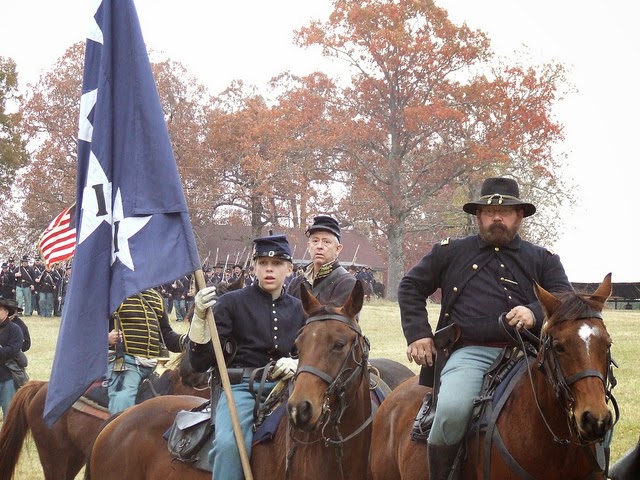
Michigan Cavalry in East Tennessee 1863-64


Photo credit: dishfunctional Some rights reserved

8th Cavalry

The regiment then in the 1st Brigade 2d Cavalry Corps and still in command of Colonel Wormer had entered upon the East Tennessee campaign having met the enemy at Kingston September 1st and on the 18th at Cleveland. A correspondent writing to the Detroit Advertiser and Tribune says of the affair at Cleveland:

'From Kingston we were ordered to Post Oak Springs a distance of nine miles. Here we remained over night. The next morning we received orders to go to Athens, the county seat of McMinn county, 35 miles south of Kingston on the line of the East Tennessee and Georgia railroad. At Kingston we had to cross the Tennessee river in a small ferry boat, the rebels having burned all the boats of any size on the river at this point, and above as far as Knoxville. It required one day and two nights to ferry the command the 1st brigade across the river. We were heartily glad when the work was accomplished. We then moved on that day some twenty miles and encamped on Prigmore's farm. Prigmore proved to be a rebel of the deepest dye, and owned a very large plantation, which was under a high state of cultivation. We found an abundance of forage for our horses and mules and quite a large quantity of bacon which the old man had buried in a smoke house to prevent the 'dreaded Yankees' from getting it. After two days sojourn we left for Athens. The 8th Michigan cavalry took the advance and we entered the town amidst the waving of flags the shouts of the people and a shower of bouquets from the hands of the loyal ladies. Such a demonstration was unexpected. We little dreamed that such a strong Union feeling existed in this section. We had heard it said that there were many loyal people in East Tennessee, but had somewhat been led to believe that it was overrated. We were indeed happily disappointed. Crowds of people gathered around Colonel Byrd and expressed their gratitude for being delivered from the oppressive yoke of the bogus confederacy. A large crowd of men and women gathered together and listened eagerly and attentively to the speeches made by Colonel Byrd, Lieutenant Colonel Wormer, 8th Michigan cavalry and Colonel Henderson of the 112th Illinois mounted infantry. Their speeches were received with bursts of applause and every one seemed pleased with the policy of our government as explained by the speakers. We remained at Athens a week or more during which time Captain Samuel Wells of the 8th Michigan cavalry, Acting Provost Marshal on Colonel Byrd's staff administered the oath to over 1,500 rebel soldiers and a large number of citizens. The captain, by the way, is a very efficient officer and attends to the duties of provost marshal in a manner satisfactory to all. While at Athens, Major Edgerly of the 8th Michigan cavalry with one company from the 112th Illinois, one company from the 1st Tennessee and companies G and I of the 8th Michigan cavalry, were sent down to Cleveland 25 miles from Athens on the East Tennessee and Georgia railroad to take possession of the town and hold it if he could. The second day after taking possession he was suddenly attacked by a largo force of the enemy estimated at 1,500, the Major's force numbering 150 and was compelled to beat a hasty retreat. The rebs had laid their plans to gobble up the major and his entire command, but they found that it was not so easily done as they supposed. Although they drove our pickets in, rather unceremoniously the Major was prepared to give them a warm reception. In the skirmish, Captain Dickinson of Company B of the 112th Illinois was killed and 24 of his men taken prisoners. The captain exhibited great courage and would not fall back, nor allow his men to retreat. Major Edgerly fell back in good order, occasionally making a stand and giving the rebels a taste of bullets. Companies G and I covered the retreat and their Spencer rifles told with fearful effect on the advancing enemy. A few volleys from their rifles would always check the rebels and they would hesitate some time before advancing. Arriving at Charleston, on the Hiawasse river, the major made a stand, but the enemy did not think proper to pursue them farther. A number of men belonging to Company G 8th Michigan were cut off and taken prisoners. A great many narrow escapes were made, several horses were shot under their riders, but no one was wounded or killed on our side. Lieutenant McDonald of Company I received a shot through his hat and another through his holster on the saddle. The officers and men praise Major Edgerly for the coolness and bravery he exhibited and the skill he displayed in keeping the enemy from capturing the whole command. But few they state could have managed the retreat so well against so large a force."


The regiment was in engagements with the enemy at:
Triplett Bridge Ky June 19 1863
Lebanon Ky July 5 1863
Sal visa Ky July 7 1803
Cumniings Ferry Ky July 9 1863
Bufriington's Island Ohio July 19 1803
Saliueville Ohio July 26 1863
Loudon Tenn September 2 1863
Cumberland Gap Tenn September 9 1863
Carter's Station Tenn September 21 1863
Zollicoffer Tenn September 25 1863
Leesburg Tenn September 29 1863
Blue Springs Tenn October 5 and 10 1863
Rheatown Tenn October 11 1863
siege of Knoxville Tenn December 5 1863
Morristown Tenn December 10 1863
Russellville Tenu December 12 1863
Bean's Station Tenn December 14 1863
Rutledge Tenn December 15 1863
Dandridge Tenn December 25 1863
Mossy Creek Tenn December 26 1863
Kinsboro's X Roads January 16 1864
Dandridge Tenn January 17 1864
Fair Garden Tenn January 24 1864
Sevier ville Tenn January 27 1864
Strawberry Plains Tenn January 1864
Morristown Tenn March 19 1864
Charles X Roads Tenn March 20 1864
Cynthiana Tenn June 12 1864 

9th Cavalry
The regiment having again been united at Covington, proceeded to Hickman's Bridge and participated in the expedition of General Burnside into East Tennessee, arriving at Knoxville September 3rd, having skirmished at Loudon on the 2nd. From Knoxville it proceeded to Cumberland Gap. On the 7th, a detachment of the regiment drove in the rebel pickets, entered the Gap, and burned a large mill, on which the enemy depended, to a great extent, for subsistence. Loss of the regiment one killed and one wounded.


Loudon Tenn September 2 1863
Cumberland Gap Tenn September 9 1863
Carter's Station Tenn September 21 1863
Zollicoffer Tenn September 25 1863
Leesburg Tenn September 29 1863
Blue Springs Tenn October 5 and 10 1863
Rheatown Tenn October 11 1863
siege of Knoxville Tenn December 5 1863
Morristown Tenn December 10 1863
Russellville Tenn December 12 1863
Bean's Station Tenn December 14 1863
Rutledge Tenn December 15 1863
Dandridge Tenn December 25 1863
Mossy Creek Tenn December 26 1863
Kinsboro's X Roads January 16 1864
Dandridge Tenn January 17 1864
Fair Garden Tenn January 24 1864
Sevierville Tenn January 27 1864
Strawberry Plains Tenn January 1864
Morristown Tenn March 19 1864
Charles X Roads Tenn March 20 1864
Cynthiana Tenn June 12 1864

10th Cavalry
Engagements and skirmishes of the regiment were:
House Mountain Tenn January 1864
Bean's Gap Tenn March 26 1864
Rheatown Tenn April 24 1864
Jonesboro Tenn April 25 1864
Johnsonville Tenn April 25 1864
Watauga Tenn April 25 1864
Powder Spring Gap Tenn April 28 1864
Dandridge Tenn May 19 1864
Greenville Tenn May 30 1864
White Horn Tenn May 31 1864
Morristown Teun Jane 2 1864
Bean's Station Tenn June 16 1864
Rogersville Tenn June 17 1864
Kiugsport Tenn June 18 1864
Cany Branch Tenn June 20 1864
New Market Tenn June 21 1864
Moseburg Tenn June 23 1864
Williams Ford Tenn June 25 1864
Dutch Bottom Tenn June 28 1864
Sevierville (725)Tenn July 5 1864
Newport Tenn July 8 3864
Morristown Tenn August 3 1804
Greenville Tenn August 4 1864
Mossy Greek Tenn  August 18 1864
Bull's Gap Tenn August 21 1864
Blue Spring Tenn August 23 1864
Greenville Tenn August 23 1864
Strawberry Plains Tenn August 24 1864
Flat Greek Bridge Tenn August 24 1864
Rogersville Tenn August 27 1864
Bull's Gap Tenn August 29 1864
Greeneville Tenn September 4 1804
Sweetwater Tenn September 10 1864
Thorn Hill Tenn September 10 1864
Sevierville Tenn September 8 1864
Jonesboro Tenn September 30 1864
Johnson Station Tenn October 1 1864
Watauga Bridge Tenn October 1 and 2 1864
Chucky Bend Tenn October 10 1854
Newport Tenn October 18 1864
Irish Bottoms Tenn October 25 1804
Madisonville Tenn October 30 1864
Morristown Tenn November 20 18G4
Strawberry Plains Tenn November 23 and 24 1864
Kingsport Tenn December 12 1864
Bristol Tenn December 14 1834
Saliville Va November 20 1864
Chucky Bend Tenn January 10 3865
Brabson's Mills Tenn March 25 1865

(Source: Michigan in the War, Michigan. Adjutant-General's Department, State Printers, 1882)


Thursday, April 9, 2015

Where was your family when Lee's Surrendered to Grant?


Hartsell Good: 4th Regiment, Tennessee Infantry, died before Lee surrendered to Grant.  He is buried in the National Cemetery in Nashville


William Elbert Milburn: Chaplin Tennessee 8th Calvary, was in Knoxville, Tennessee


John Francis M Bails: Tennessee 8th Calvary, was in Knoxville, Tennessee


Wiley Bailey: 7th Regiment, Tennessee Mounted Infantry, was in Athens, Tennessee